Septic tanks vs. sewage treatment plants: what’s the difference?
The real differences between a septic tank and a sewage treatment plant, and which suits your property.
Key takeaways
- A sewage treatment plant treats waste and needs electricity, while a septic tank only separates waste and runs without power.
- Treatment plants have mechanical parts, so they need a permanent electricity supply.
- A typical septic tank has two zones, while a sewage treatment plant usually has three.
- Water leaving a treatment plant is cleaner, so it can go straight to a local watercourse.
- Since 1 January 2020, a septic tank discharging to a watercourse is no longer legal and must be upgraded.
- If you're buying a property with a septic tank that discharges to a watercourse, agree the upgrade before you go ahead.
Ok so ‘septic tanks vs. sewage treatment plants’ might not be much of a battle worth watching, but if you have a property with an off-mains drainage system, or are thinking of buying one, it’s worth knowing the difference.
This is all the more important bearing in mind the change in legislation to do with septic tanks which takes effect in 2020. This will make certain types of drainage systems involving septic tanks no longer legal. So knowing whether you have a septic tank or a sewage treatment plant lurking underground at your property could save you a whole lot of trouble and possibly a weighty fine.
If you’re buying a property, it’s really important too, buy a house without knowing whether it has a septic tank or a sewage treatment plant at your peril, as you could find yourself on the hook for a big fat bill to upgrade your system in 2020.
So, what are the main differences between septic tanks and sewage treatment plants?
A septic tank settles the waste and lets the liquid soak into the ground through a soakaway. A sewage treatment plant adds a powered stage that aerates the waste, producing a cleaner effluent that can discharge to a watercourse.
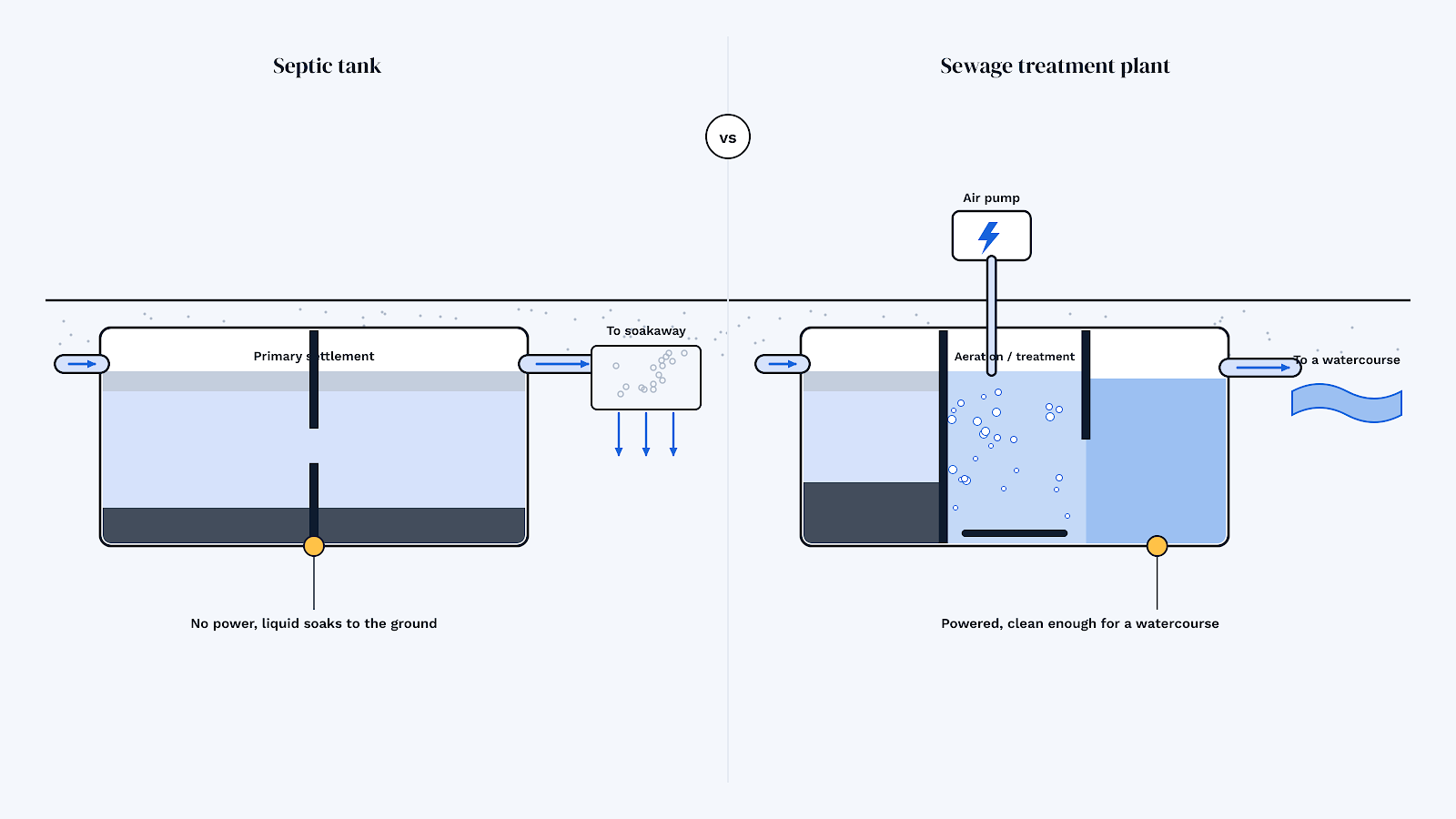
Here are the main differences between the two
- Sewage treatment plants have mechanical components, which means that they need a permanent electrical supply to operate. There are no such components in a septic tank, and so it operates without a power supply.
- A typical septic tank has two ‘zones’, whereas a sewage treatment plant typically has three.
- A sewage treatment plant provides treatment of the waste, whereas a septic tank simply separates it. This means that the waste water that leaves a sewage treatment plant is cleaner than what leaves a septic tank. You still might not want to brush your teeth with it, but it’s certainly a lot more environmentally friendly.
- As a result of the cleaner waste water that leaves a sewage treatment plant, you can discharge the waste water straight to a local watercourse. There are a lot of properties out there which currently have a septic tank that discharges to a local watercourse (instead of to a soakaway system or drainage field). As of January 1st 2020, this is no longer legal. What does this mean to you? If you own a property with this drainage system, you must upgrade it by that date. If you are selling a property with this system in place before 2020, you must upgrade it before selling. If you are buying a property with a septic tank discharging to a watercourse and this hasn’t yet been discussed, don’t! Until agreement has been made about upgrading the system. Click here to find out about our Home Buyer Drainage Surveys and the peace of mind you get from knowing exactly what you are taking on.
A cesspit is a third option, though it only stores waste rather than treating it.
Frequently Asked Questions
Where does a cesspit fit in, and how is it different?
A cesspit is a sealed holding tank. It treats nothing and has no outlet, so everything that goes in stays there until it's emptied, which means emptying far more often and a higher running cost. A septic tank and a treatment plant both treat and discharge; a cesspit is a last resort where neither is possible.
Can I replace my septic tank with a sewage treatment plant?
Yes, and it's the usual way to become compliant if your septic tank can't discharge to a proper drainage field. A treatment plant cleans the water enough to discharge to a watercourse where the rules allow. The old tank is decommissioned as part of the works.
Which costs more to run, a septic tank or a treatment plant?
A septic tank costs the least to run, because it uses no power and only needs emptying. A treatment plant uses electricity and needs servicing as well as emptying, so it costs a little more each year. In return it produces cleaner water and works where a septic tank can't.
Does a sewage treatment plant still need emptying?
Yes. It still needs emptying, usually about once a year, and the pump and blower need servicing to keep it working. A treatment plant is lower-maintenance than a cesspit, but it isn't maintenance-free.
Which one is right for my property?
It comes down to your ground and whether you can discharge to a drainage field. A septic tank suits sites with suitable ground and space; a treatment plant suits sites that can't support a drainage field or need to discharge to a watercourse. A survey and percolation test tell you which will work before you commit.
About the author
Sam Warren
UKDP co-founder
Sam Warren co-founded UKDP with James Warren in 2009 as an off-mains drainage specialist.
Need help with your septic tank or drainage?
Reach out to us on 0800 028 9903. Our team are here to talk Monday to Friday 9am to 5pm.