
Septic tank in clay soil? Find out why it matters and what you can do
Why clay soil stops a soakaway draining, and the options when the ground won't take the water.
Key takeaways
- Clay soil stops waste water draining through a soakaway, and your options are a soakaway on non-clay ground or a sewage treatment plant.
- A septic tank separates waste into three layers, and only the middle layer of waste water leaves through the outlet pipe.
- A soakaway system treats that water as it passes through the gaps between soil particles, and clay leaves those gaps too small.
- Since 1 January 2020, a septic tank can no longer discharge straight to a watercourse or ditch.
- A sewage treatment plant's cleaner water can go to a watercourse, a deep ring soakaway or a borehole soakaway, with Environment Agency approval.
- Start with a percolation test to see whether any of your ground suits a soakaway, and consider a sewage treatment plant if none does.
A property owner recently contacted us through our website, explaining that they had a septic tank in clay soil and asking us if this might be the cause of their septic tank problems.
Here at UKDP we spend every day talking about septic tanks and other off-mains drainage systems (and yes, we are as interesting as we sound), so we know all about different types of soil and why they may or may not be appropriate for different types of drainage systems. We also know all about the rules and regulations that set down what you can and can’t do when it comes to drainage systems and types of soil.
Don’t worry, there’s no need for you to become an expert, I’ll explain it all here for you to save you the bother. If any of it doesn’t make sense, or if you’d like any more information, just get in touch with our friendly team who’d be very happy to talk septic tanks with you.
Why does it matter if you have a septic tank in clay soil?
Firstly, it’s useful to know how a septic tank works. I’ll go into the basics here, but if you’d like to know more detail you can check out our guide.
Septic tanks don’t really perform much in the way of treatment for the waste from you property’s toilets and sinks. Really, they just provide a separation of the waste that goes in, into three layers (it’s worth not dwelling on what that might look like if you’re eating your lunch). The middle layer of separated waste water is what leaves the tank, the rest is retained inside it and it’s this which gets removed during your regular septic tank empty. The waste water heads out of the tank through the outlet pipe and on to one of the following:
A soakaway system or drainage field
Typically, this is a system of slotted or perforated pipes which provides some treatment of the waste water, as it enables it to pass safely through the particles of the sub soils. The waste water is able to pass into the ground without causing any pollution (assuming of course that the soakaway system or drainage field is working as it should be). Sometimes your septic tank might discharge straight to a soakaway pit, which works on the same principles as the slotted or perforated pipework.
A sealed pipe which runs straight to a local watercourse or a ditch
Please be aware that as of January 1st 2020, you will no longer be able to have the waste water from a septic tank going straight to a watercourse or ditch. You can read more about the legislation change and what it means in our Guide. The reason for the change is because it is no longer considered that the waste water is clean enough to pass straight into watercourses without having been treated (as it would be if it passed through a soakaway system).
So why is it relevant if you have a septic tank in clay soil?
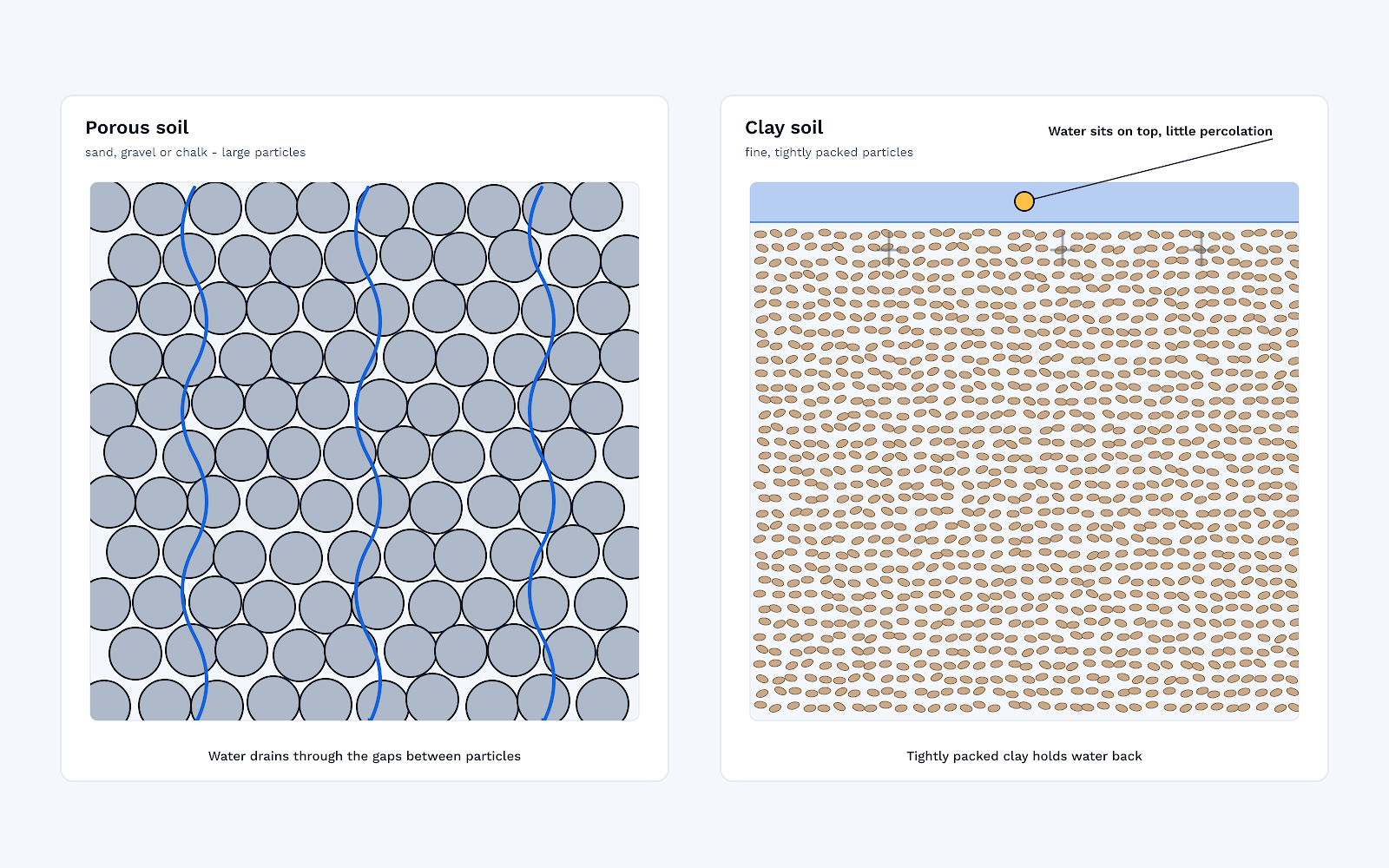
Assuming that your septic tank goes to a soakaway system, the problem is that it will only function properly in certain types of soil. It’s all to do with the tiny gaps between the particles in the sub soils, through which the waste water passes.
The long and short of it is that if the gaps between the particles are too small (or there are no gaps at all), the waste water can’t pass through. Clay soil is the main culprit here, as it stops the waste water from passing through and being treated as it needs to be. This can cause some serious soakaway problems.
Soil type decides whether a soakaway can cope. Water drains through the gaps in porous ground like sand or gravel, but tightly packed clay holds it, so the liquid backs up with nowhere to go.
What are your options if you have a septic tank in clay soil?
Unless you have another area within your property’s boundary which does not have clay soil, then a soakaway system or drainage field is unlikely to work. The way to determine the type of soil and how porous it would be is through a percolation test. If you’re unsure, then this is a good place to start as it will tell you whether any area of the ground at your property is suitable, and if so, what size and design of soakaway system might be needed.
If a percolation test shows that the ground at your property is not suitable for a soakaway system, then the second option is to replace your septic tank with a sewage treatment plant. A sewage treatment plant produces a better quality of waste water, which gives you more options about where the waste water leaving the plant can go. For example, you could discharge the waste water straight to a local watercourse, alternatively you could install a deep ring soakaway chamber or a borehole soakaway (subject to Environment Agency approval).
In summary, having a septic tank in clay soil can be a challenge, but there are always options.
Frequently Asked Questions
Can you have a septic tank in clay soil at all?
Often not a traditional one, because clay won't let the soakaway drain. Where the ground is heavy clay, a sewage treatment plant that can discharge to a watercourse is usually the workable option. A percolation test confirms what your ground will take.
How do I know if my ground is too clay-heavy for a soakaway?
A percolation test is the only reliable way. It measures how fast water drains from test pits; if it's too slow, the ground won't support a soakaway and you'll need an alternative.
What are the alternatives to a soakaway in clay soil?
The main one is a sewage treatment plant, which cleans the water enough to discharge to a ditch or watercourse where the rules allow. On some sites a deep bore soakaway works. There's no cheap shortcut; it comes down to what your ground allows.
Why does my septic tank struggle more in wet weather?
Clay holds water, so in wet months the ground around the soakaway is already saturated and can't take any more. That's when a borderline system backs up, a sign the drainage field is near its limit.
Does clay soil mean a more expensive drainage system?
It can, because you may need a treatment plant rather than a simple soakaway, and installed systems start around £10,000 to £12,000. A percolation test first (from £950) makes sure you spend on the right solution.
About the author
Sam Warren
UKDP co-founder
Sam Warren co-founded UKDP with James Warren in 2009 as an off-mains drainage specialist.
Need help with your septic tank or drainage?
Reach out to us on 0800 028 9903. Our team are here to talk Monday to Friday 9am to 5pm.