
Percolation tests
What a percolation test is, how it's carried out, and what the result tells you about your drainage field.
Key takeaways
- A percolation test measures how fast water drains into the ground, to show whether a drainage field will work and how big it should be.
- A drainage field uses perforated pipes to let wastewater soak into the subsoil, which treats it before it reaches the environment.
- If the ground is too wet or too impermeable, the wastewater backs up into the tank and the system surcharges.
- The test uses at least two pits dug to the depth of the drainage field, flooded and left to drain, and shouldn't happen in heavy rain.
- Refilling the pits and timing how fast the water seeps away gives a percolation value, or Vp, which sets the field's size and layout.
- If the test fails, you can't use a septic tank and will need a treatment plant draining to a watercourse or a bespoke soakaway.
- Have a percolation test done before you install a drainage field or choose an off-mains system for a property.
What is a percolation test? When is one needed? Why is it so important?
If a property is not connected to a main sewer, it will be connected to an off-mains drainage system such as a septic tank, sewage treatment plant or cesspit.
If the property has a septic tank or a sewage treatment plant, the waste water from the tank will discharge either to a soakaway system such as a drainage field or to a watercourse. It’s good to be aware of the General Binding Rules here, which determine whether you are legally allowed to discharge to a watercourse. You can read our Guide to Septic Tank Regulations here.
If a septic tank or treatment plant is to discharge to a drainage field, a percolation test will be required.
This guide explains what a percolation test is, when it’s needed and why it’s important. It also outlines the basics of what’s involved in a percolation test, and how the results can be interpreted.
What is a drainage field?
The purpose of a drainage field is to allow the wastewater leaving the septic tank or treatment plant to safely percolate into the ground. It is the percolation of the waste water through the subsoils which provides a form of treatment of the water, and allows it to pass into the local environment without causing pollution. A drainage field is typically comprised of a network of perforated or slotted pipes, which allow the waste water to pass into the surrounding sub soils.
What is a percolation test and why is it required?
The suitability of the ground conditions at a property are crucial to whether a drainage field will function properly, because the ground must be sufficiently porous to allow the wastewater to pass into it. If the ground is too wet or too impermeable, the wastewater will not be able to pass into it, and it will return to the septic tank or treatment plant, causing the system to surcharge. A percolation test measures the rate at which the waste water passes into the ground. If this happens too quickly or too slowly, the ground would be considered unsuitable. If a percolation test demonstrates that the ground conditions are suitable for a drainage field, it will also determine what the dimensions of the drainage field should be. If you are installing a drainage field, or determining what type of off-mains drainage system is required at a property, a percolation test is essential.
How is a percolation test carried out?
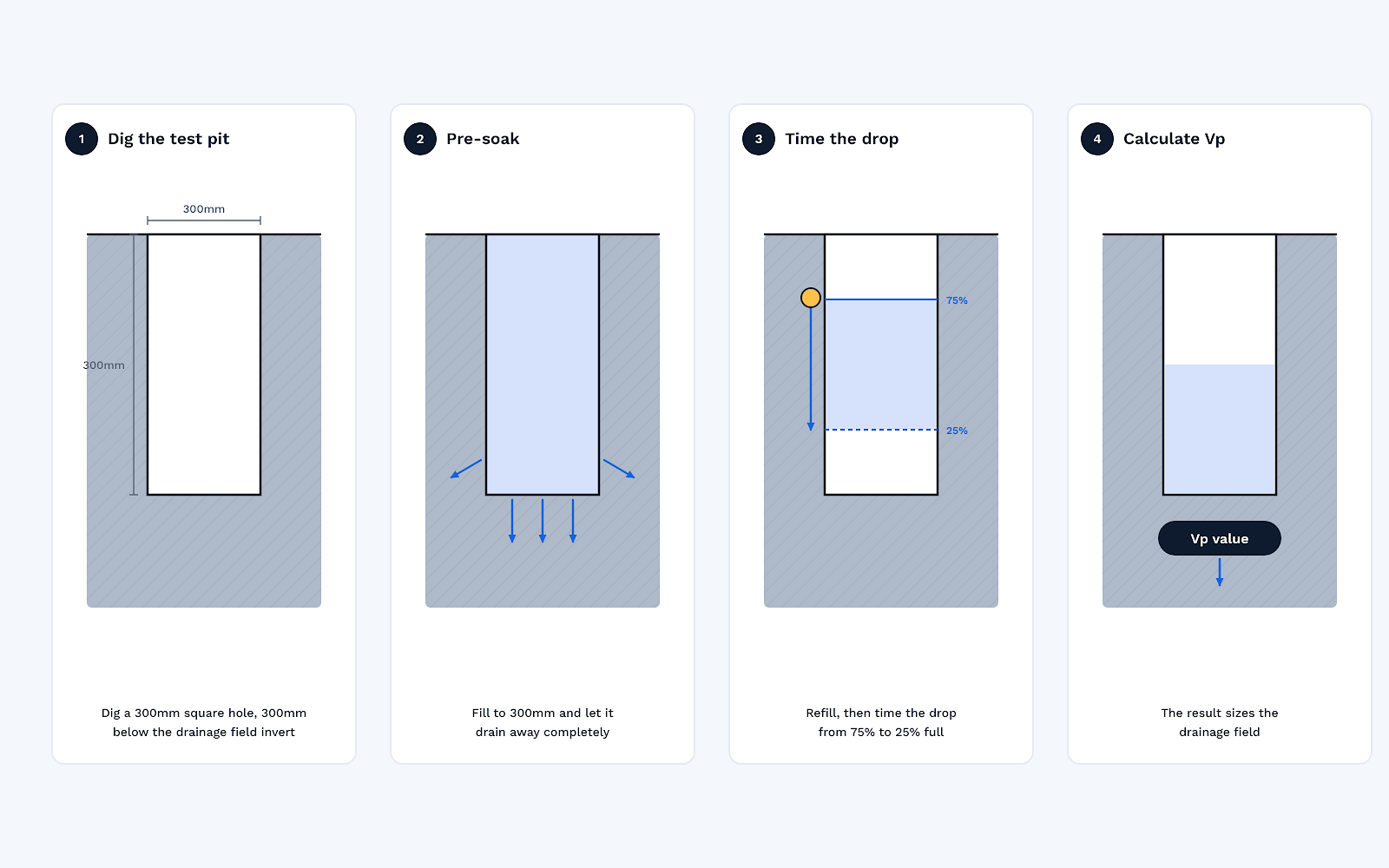
A percolation test typically involves a minimum of two test pits being dug in the area of a proposed drainage field. The weather on the day of the test can be important, as the tests shouldn’t be carried out during periods of heavy rainfall. This is because it can affect the results by making the ground more saturated than usual, and can also provide false results by filling up the test pits. The British Standard Code of Practice for the Design and Installation of Drainage Fields for Use in Wastewater Treatment sets out in detail how a percolation test should be carried out. It states that a minimum of two test pits are required. In our experience, three test pits gives a more reliable result, and this is what we would recommend. The test pits should be dug to the depth that any proposed drainage field would be installed. The British Standard document states that the pits should be excavated to a depth at least 300 mm below the proposed invert level (measured from the bottom of the pipe) of the drainage field. Once the test pits have been dug, they should be flooded first, and the water should be left to drain away completely. If the water drains away too quickly or too slowly, as per the guidelines set down by the British Standard document, the ground would be considered unsuitable.
A percolation test measures how fast water drains from a pit dug below the drainage-field level. You soak the pit, refill it, then time the drop from 75% to 25% full, and that figure sizes the drainage field.
What is a Vp?
If the water has drained away within an acceptable timeframe as above, the percolation test can be continued. This involves measuring the rate at which water seeps away from the pits, once they are refilled with water, and using this to calculate a percolation value (Vp). The results from the test are then used to calculate the size and layout of the drainage field required.
What happens if a percolation test fails?
The General Binding Rules for Small Sewage Discharges set down what type of drainage systems are allowed. A septic tank is not allowed to discharge straight to a watercourse or ditch, it must discharge to a drainage field. A treatment plant provides a level of treatment of the wastewater before it exits the tank, and is therefore generally allowed to discharge to a watercourse or ditch. If one is not within close proximity, it can also discharge to a drainage field. If a percolation test fails, meaning that a drainage field is not appropriate for the property, a septic tank would not be suitable for the property. The options then available are: A treatment plant discharging to a nearby ditch or watercourse (if one is available) or A treatment plant discharging to a bespoke soakaway arrangement. You would need to obtain a Permit for Consent to Discharge from the Environment Agency if the property is in England, NRW in Wales, SEPA in Scotland and NIEA in Northern Ireland.
Frequently Asked Questions
How much does a percolation test cost?
A percolation test starts from around £950. It's carried out over two days and gives you the soil's drainage rate, which sizes the drainage field correctly so you don't over- or under-spend on the system.
Can I do a percolation test myself?
You can dig trial holes, but a test that will satisfy Building Control or the Environment Agency needs to follow the British Standard method and be properly recorded. For a system you're installing or selling, it's worth having it done correctly.
How long does a percolation test take?
Two days. The trial pits are dug and soaked on the first day and left overnight, then the drainage rate is measured the next day. It's avoided during heavy rain or frost, which skew the result.
What's a good percolation test result?
One where the water drains neither too fast nor too slowly: too fast and the ground won't treat the wastewater, too slow and it won't soak away. The measured rate (the Vp value) feeds a formula that sizes the field.
Do I need a percolation test to install or replace a septic tank?
Yes, if the system discharges to a drainage field. It's how the field is sized and how you show the ground is suitable, so it's one of the first steps before any installation.
About the author
Sam Warren
UKDP co-founder
Sam Warren co-founded UKDP with James Warren in 2009 as an off-mains drainage specialist.
More Handy Guides
Need help with your septic tank or drainage?
Reach out to us on 0800 028 9903. Our team are here to talk Monday to Friday 9am to 5pm.